
Contents
- 0.1 The Lord’s Prayer, a central element of Christian worship, embodies key themes of forgiveness, unity, and trust in God, originating from the teachings of Jesus.
- 0.2 Its significance has evolved over centuries, influencing various Christian traditions and cultural expressions, including music and art. Today, it serves as a vital prayer in personal spirituality and interfaith dialogue, reflecting humanity’s shared values and the call to love one another.
- 1 The Biblical Origins of the Lord’s Prayer
- 2 Historical Context: Jesus and His Disciples
- 3 Evolution of the Prayer in Early Christianity
- 4 The Lord’s Prayer in Different Traditions
- 5 Modern Interpretations and Uses
- 6 Cultural Impact of the Lord’s Prayer Today
- 7 Conclusion
- 8 Frequently Asked Questions about the Lord’s Prayer
- 8.1 What is the Lord’s Prayer?
- 8.2 What are the biblical origins of the Lord’s Prayer?
- 8.3 How has the Lord’s Prayer evolved in early Christianity?
- 8.4 How is the Lord’s Prayer used in different Christian traditions?
- 8.5 What modern interpretations exist for the Lord’s Prayer?
- 8.6 What cultural impacts does the Lord’s Prayer have today?
The Lord’s Prayer, a central element of Christian worship, embodies key themes of forgiveness, unity, and trust in God, originating from the teachings of Jesus.
The History of the Lord’s Prayer is a fascinating journey that unveils its origins and evolving significance.
Rooted deep in the teachings of Jesus, this prayer has been a cornerstone of Christian faith across centuries.
From its biblical foundations to the adaptations made in various traditions, the Lord’s Prayer continues to inspire millions around the globe.
In this article, we will explore the rich history and the enduring relevance of this prayer in contemporary society.
The Biblical Origins of the Lord’s Prayer
The Biblical Origins of the Lord’s Prayer trace back to the teachings of Jesus Christ, specifically found in the New Testament. The prayer is recorded in two key passages: Matthew 6:9-13 and Luke 11:2-4. In these verses, Jesus responds to his disciples’ request to teach them how to pray, highlighting the importance of direct communication with God.
In Matthew, the Lord’s Prayer appears within the Sermon on the Mount, a profound collection of Jesus’ teachings aimed at guiding his followers in their spiritual lives. Here, He emphasizes the need for sincerity in prayer, instructing the crowd to avoid empty phrases and instead approach God with humility and trust.
Luke’s account provides a slightly more condensed version, but it echoes the same fundamental principles of seeking God’s will and recognizing His holiness. The phrase ‘Our Father who art in heaven’ illustrates a personal relationship between believers and God, presenting Him as a loving parent watching over His children.
The context of the prayer in these biblical passages reflects not only a spiritual guideline but also a revolutionary approach to prayer for that time. Jesus offered a more intimate and accessible way to connect with God, moving away from the formal and ritualistic practices common among religious leaders. This progressive nature of the prayer laid the foundation for its profound impact on Christian worship and personal devotion throughout history.
Historical Context: Jesus and His Disciples

The Historical Context: Jesus and His Disciples during the time of the Lord’s Prayer is crucial for understanding its significance.
Jesus lived in a period when the Jewish community was deeply rooted in traditions and religious practices. Prayer was a vital part of daily life, often characterized by formal rituals and extensive recitations of scripture.
Jesus and His disciples were part of a tumultuous first-century Judea, under Roman occupation, where the Jewish people faced immense challenges. This context shaped Jesus’ ministry as he sought to uplift the marginalized and teach a message of love and forgiveness. His interactions with people from various backgrounds demonstrated a more personal, relational approach to spirituality.
When the disciples asked Jesus how to pray, their request reflected a desire to connect more meaningfully with God. They witnessed Jesus often retreating to solitary places for prayer, where he engaged in deep communion with the Father. This model of prayer contrasted sharply with the more public and ostentatious prayers prayed by the Pharisees at the time, who sought to showcase their piety.
The Lord’s Prayer, as taught by Jesus, encapsulated key values such as humility, dependency on God, and the communal aspect of faith. The phrase ‘Our Father’ not only signifies a personal relationship but also implies a shared identity among believers as members of God’s family. This shift in perspective from individualistic to communal prayer reflects Jesus’ transformative teaching style and aimed to foster a deeper sense of unity among his followers.
In essence, the historical backdrop of Jesus and His disciples informs our understanding of the Lord’s Prayer. It wasn’t just a formula for communication with God; it became a radical declaration of faith that challenged existing norms and invited believers into a deeper, more authentic relationship with the divine.
Evolution of the Prayer in Early Christianity
The Evolution of the Prayer in Early Christianity reveals how the Lord’s Prayer became a fundamental component of Christian worship and practice. After Jesus’ resurrection and ascension, his followers began to spread the teachings throughout the Roman Empire. Early Christians viewed the Lord’s Prayer not just as a personal prayer but as a communal declaration of faith that exemplified Jesus’ teachings and principles.
In the first few centuries of Christianity, the prayer’s structure and components remained largely consistent, reflecting its deep roots in the Gospels. However, as the church grew and diversified, different Christian communities adapted the prayer to cater to their cultural and liturgical contexts. This adaptability contributed to its universal appeal, allowing it to resonate across various regions and traditions.
Moreover, the Lord’s Prayer was incorporated into early Christian liturgies and rituals. It became a staple in communal worship, often recited during the Eucharist, reinforcing the themes of forgiveness and divine provision. Manuscripts from the early church show variations in wording, highlighting how local dialects and practices influenced its expression without altering its core message.
One of the notable developments in the evolution of the Lord’s Prayer was the inclusion of additional phrases and interpretations. For example, some early Christian writings, like the Didache and the writings of Church Fathers, introduced slight modifications that emphasized the prayer’s theological significance, further enriching its meaning.
By the time of the Council of Nicaea in 325 AD, the Lord’s Prayer had become firmly entrenched in Christian worship worldwide. Its inclusion in the Nicene Creed showcased its importance among the foundational teachings of the Church. The prayer then solidified its place within Christian doctrine, serving as a daily reminder for believers of their relationship with God and their mutual obligations to one another.
In summary, the evolution of the Lord’s Prayer in early Christianity reflects the adaptability and resilience of Jesus’ teachings. From its biblical origins to its integration into early church liturgy, the prayer has served as a powerful spiritual tool, uniting believers around core Christian values across centuries.
The Lord’s Prayer in Different Traditions
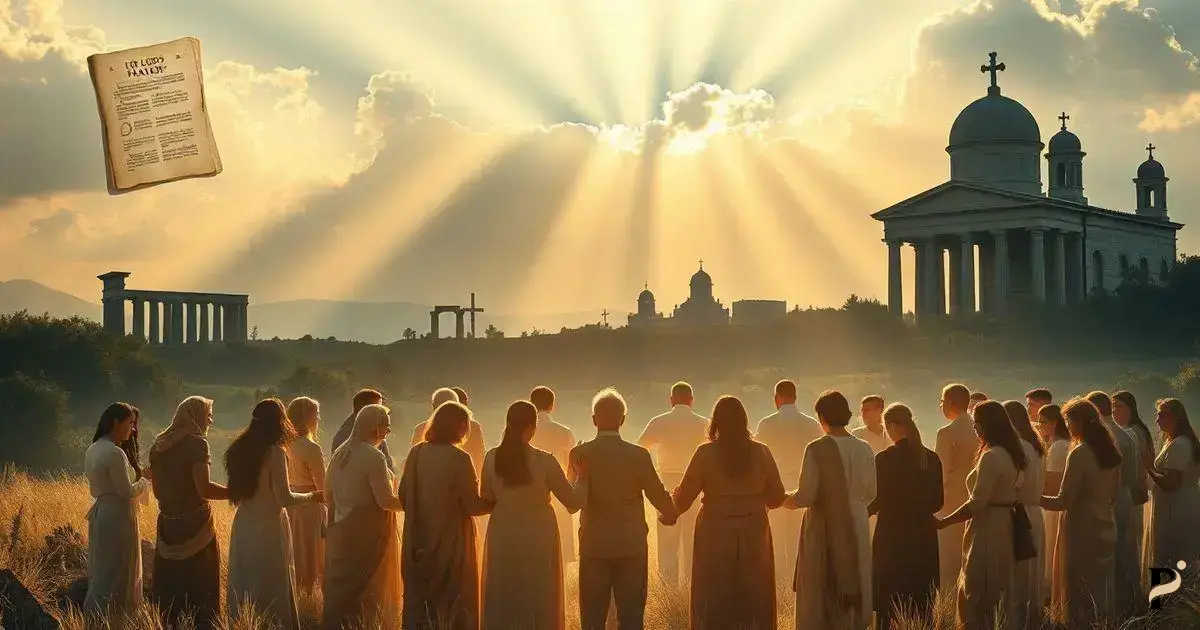
The Lord’s Prayer in Different Traditions showcases its remarkable journey as it has been embraced, adapted, and interpreted across various Christian denominations and cultures. While the essence of the prayer remains consistent, different traditions have infused it with unique characteristics that reflect their theological perspectives and liturgical practices.
In Roman Catholicism, the Lord’s Prayer is an integral part of the Mass. It is recited by the congregation during the Eucharistic celebration, emphasizing unity within the community of believers. Additionally, the prayer includes the phrase “forgive us our trespasses,” highlighting the importance of repentance and forgiveness in the Catholic faith.
Protestant denominations, such as Lutherans, Methodists, and Baptists, also incorporate the Lord’s Prayer into their worship services, often using the wording “forgive us our debts” or “forgive us our sins.” This variation illustrates differing theological emphases on grace and accountability. In some Protestant traditions, the Lord’s Prayer may be recited in a more informal or personal manner, inviting congregants to approach it as a guide for their individual prayer life.
In Eastern Orthodoxy, the Lord’s Prayer takes on a more mystical and contemplative significance. It is often included in the Divine Liturgy and is considered a prayer that connects heaven and earth. Orthodox believers emphasize the prayer’s role in fostering humility and dependence on God’s grace, reflecting their theological emphasis on the transformative power of prayer.
Additionally, many African and Asian Christian communities incorporate local languages, cultural expressions, and music into their recitation of the Lord’s Prayer. This adaptation fosters a sense of belonging and reinforces the idea that the prayer transcends cultural boundaries, uniting believers of diverse backgrounds in a shared faith.
The ecumenical movement has further facilitated a dialogue among different Christian traditions regarding the Lord’s Prayer. Many churches now collaborate in joint services, creating spaces for diverse expressions of worship that honor the prayer’s universal significance. This collaborative spirit helps build bridges and promote understanding among different denominations.
In conclusion, the Lord’s Prayer resonates through the myriad of Christian traditions, each reflecting a distinct understanding of its rich depth and meaning. Despite the variations in wording and context, the prayer continues to serve as a powerful and unifying call to draw closer to God and to one another in faith.
Modern Interpretations and Uses
The Modern Interpretations and Uses of the Lord’s Prayer reveal its enduring relevance in the contemporary world. Today, this powerful prayer transcends its traditional religious boundaries, becoming a source of inspiration, comfort, and unity for diverse groups and individuals.
In many Christian congregations, the Lord’s Prayer is recited not only as a ritual but as a meaningful expression of communal faith. Modern worship services in various denominations often feature the prayer prominently, using it as a tool for teaching and reflecting on core Christian values such as forgiveness, humility, and divine provision. This communal recitation fosters a sense of belonging and solidarity among believers, reinforcing the prayer’s role as a cornerstone of Christian identity.
Beyond formal worship, the Lord’s Prayer has found its way into personal spirituality. Many people incorporate the prayer into their daily devotionals, using it as a framework for personal reflection and connection with God. In this context, individuals often meditate on each phrase, taking time to consider its implications for their lives. This focus on personal interpretation has led to various devotional resources, such as books and prayer journals, that guide believers in exploring the prayer’s depths.
Furthermore, the Lord’s Prayer has also been embraced in interfaith dialogues and discussions about spirituality and ethics. Its themes of love, forgiveness, and a call to action resonate with many people beyond the Christian faith. This inclusivity has led to adaptations of the prayer that make it more accessible to those from diverse spiritual backgrounds, allowing it to serve as a bridge in conversations about common values and shared humanity.
In popular culture, the Lord’s Prayer has been referenced in music, literature, and even film, often highlighting its powerful emotional appeal. Musicians have created adaptations that emphasize the prayer’s message, while authors and poets have used its imagery and themes to craft meaningful narratives about faith and the human experience.
Social and mental health movements have also recognized the prayer’s potential for healing and resilience. Workshops and support groups may incorporate the Lord’s Prayer into discussions about forgiveness and reconciliation, encouraging participants to explore its teachings as a means of processing personal challenges and fostering emotional growth.
In summary, the modern interpretations and uses of the Lord’s Prayer illustrate its versatility and profound impact. Whether in communal worship, personal reflection, interfaith conversations, or popular culture, this ancient prayer continues to inspire individuals and communities alike, remaining a vital part of the spiritual landscape in today’s world.
Cultural Impact of the Lord’s Prayer Today

The Cultural Impact of the Lord’s Prayer Today extends far beyond the confines of church walls, influencing various aspects of society and everyday life. This iconic prayer, deeply rooted in Christian tradition, has permeated culture, art, and even political discourse, becoming a symbol of faith and community around the globe.
In contemporary music, the Lord’s Prayer has inspired countless songs across genres, from gospel to pop and rock. Artists often incorporate references to the prayer’s themes of hope, forgiveness, and unity in their lyrics, resonating with listeners who find comfort in its timeless message. The prayer’s phrases frequently appear in the work of songwriters seeking to evoke strong emotions or convey deep spiritual truths.
The arts also reflect the ongoing cultural relevance of the Lord’s Prayer. Visual artists, filmmakers, and writers draw inspiration from its rich imagery and profound themes. Exhibits featuring artworks inspired by the prayer encourage audiences to explore its meaning in new and innovative ways, fostering engagement with its spiritual significance outside traditional religious contexts.
In the realm of politics and social justice, the Lord’s Prayer serves as a rallying cry for many activists advocating for peace, reconciliation, and compassion. The prayer has been invoked in speeches and movements addressing issues such as racial justice, poverty, and environmental stewardship, reminding individuals of their shared responsibility to care for one another and the world. Many community organizations incorporate the prayer into their activities, using it as a foundation for dialogue and collective action.
The Lord’s Prayer’s ability to bring people together across different backgrounds is also evident in interfaith gatherings and events. As a prayer that emphasizes common human values like compassion and forgiveness, it serves as a unifying element in conversations among diverse faith traditions, fostering mutual respect and understanding.
Moreover, the Lord’s Prayer has made its mark in education, often included in discussions about ethics, character development, and moral responsibility. Teachers may introduce it as a catalyst for dialogue on topics such as empathy and community, encouraging students to contemplate its teachings and apply them in real-life situations.
In summary, the cultural impact of the Lord’s Prayer today is pervasive and multifaceted. From music and art to politics and education, this prayer continues to inspire individuals and communities alike, reinforcing its role as a powerful expression of faith, hope, and connection within society.
Conclusion
The journey of the Lord’s Prayer, from its biblical origins to its modern interpretations and cultural impact, highlights its profound significance within Christianity and beyond.
Rooted in the teachings of Jesus, this prayer has evolved through the centuries, adapting to the needs and contexts of various traditions while maintaining its core message.
Its role as a foundational element in communal worship, personal spirituality, and interfaith dialogue underscores its power to unite and inspire.
As the Lord’s Prayer continues to resonate with individuals and communities today, it remains a relevant and transformative expression of faith, reminding us of our shared humanity and the call to love one another.
Frequently Asked Questions about the Lord’s Prayer
What is the Lord’s Prayer?
The Lord’s Prayer is a fundamental Christian prayer taught by Jesus to his disciples, found in the New Testament.
What are the biblical origins of the Lord’s Prayer?
The Lord’s Prayer is recorded in Matthew 6:9-13 and Luke 11:2-4, highlighting its significance in Jesus’ teachings.
How has the Lord’s Prayer evolved in early Christianity?
The prayer became a communal declaration of faith, integrated into worship practices, and adapted by different Christian communities.
How is the Lord’s Prayer used in different Christian traditions?
It is incorporated into liturgies across denominations, often with slight variations that reflect theological differences.
What modern interpretations exist for the Lord’s Prayer?
Today, it is used in personal prayer, interfaith dialogues, and is referenced in popular culture, highlighting its lasting relevance.
What cultural impacts does the Lord’s Prayer have today?
It influences music, art, social justice movements, and education, serving as a symbol of faith, unity, and moral responsibility.